App Store Optimization (ASO) is one of the most misunderstood growth channels in mobile. Below are 20 of the most common ASO questions — answered in depth, with formulas, practical examples and visuals.
📋 All 20 questions
- What is ASO?
- Why is ASO important?
- What is the difference between ASO and SEO?
- How long does ASO take to show results?
- Which factors affect app ranking most?
- How do I do keyword research for ASO?
- Where should keywords be placed?
- How important is the app title?
- Do screenshots impact ASO?
- Is app icon optimization worth it?
- Do ratings and reviews affect ASO ranking?
- How can I improve app ratings?
- What metrics should I track for ASO?
- What is ASO A/B testing?
- Should I localize my app listing?
- How often should ASO be updated?
- Can paid ads help ASO?
- What are common ASO mistakes?
- Is ASO a one-time task?
- Can small apps compete with big apps in ASO?
Question 1: What is ASO?
ASO (App Store Optimization) is the discipline of improving an app’s discoverability and conversion performance inside the Apple App Store and Google Play, so the app gains more high-intent organic installs and better downstream business outcomes (retention, revenue, LTV).
That is the formal definition. Now the expert-level breakdown.
1. The core idea
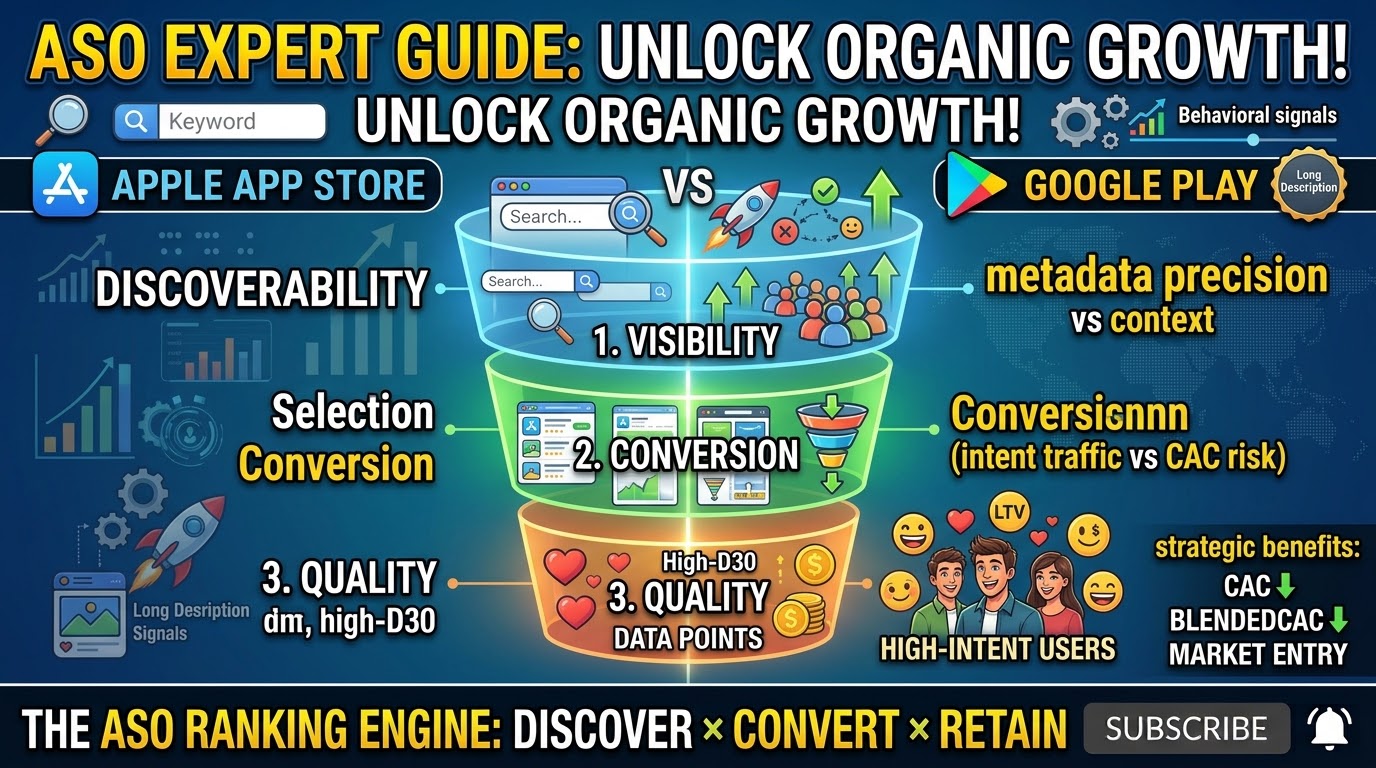
ASO is not just “adding keywords.” ASO is a full-funnel optimization system with three layers:
2. Simple mental model
Think of ASO as running a high-performing retail shelf in two giant supermarkets — Apple and Google.
3. ASO vs SEO (critical distinction)
They are related but not identical. SEO optimizes webpages for search engines like Google. ASO optimizes app listings for app-store search and browse ecosystems. The key practical difference: in SEO, backlinks and web authority are major factors; in ASO, metadata relevance + listing conversion + app quality signals dominate.
So ASO is “SEO-like,” but store-specific and conversion-heavier. (More on this in Question 3.)
4. Platform-specific reality: iOS vs Google Play
- App Name / Title
- Subtitle
- Keyword field
- In-app purchase metadata (context-dependent)
- Category / contextual signals
- App Title
- Short Description
- Long Description
- Category / context + behavioral signals
5. The ASO ranking engine in plain formula language
6. What ASO includes in real operations
- Keyword research and semantic clustering.
- Metadata writing by market and language.
- Creative strategy for icon, screenshots and video.
- Store experiment design and A/B testing.
- Ratings and review operations (prompt timing + response policy).
- Localization by country-language segment.
- Performance analytics and iteration cycles.
This is why serious ASO is cross-functional: growth, product, design, data and customer support all contribute.
7. What ASO is not
- A one-time launch checklist.
- A “keyword stuffing” trick.
- A vanity ranking game disconnected from retention.
- Guaranteed instant growth.
ASO is a continuous scientific process: hypothesis → change → measure → iterate.
8. Practical example: a budgeting app
| Metric | Before ASO | After ASO cycle | What changed |
|---|---|---|---|
| Monthly impressions | 100,000 | 150,000 | Better keyword mapping |
| Tap-through rate (TTR) | 3% | 4.2% | New icon + screenshot story |
| Install conversion (CVR) | 20% | 24% | Clearer listing + higher rating |
| Organic installs | 600 | 1,512 | Impressions × TTR × CVR |
9. Why ASO matters strategically
ASO is one of the few mobile growth channels with compounding behavior. When paid ads stop, traffic drops quickly — ASO improvements keep working for months if maintained. Strategic benefits: lower blended CAC pressure, better acquisition resilience, stronger entry into new locales, and better monetization efficiency when paired with retention quality.
10. The mature definition (expert version)
ASO is a market-by-market, experiment-driven optimization discipline that aligns app-store semantics, listing persuasion architecture and product quality signals to maximize incremental organic acquisition and lifetime value.
Question 2: Why is ASO important?
ASO is important because it improves the entire app growth equation, not just keyword rankings. At first-principles level, app growth depends on four linked stages:
1. ASO captures high-intent demand at the point of need
In app stores, users search when they already have a goal: “budget tracker,” “photo editor,” “Arabic learning.” This is not random traffic — it is problem-aware traffic. Search-intent traffic usually converts better than broad awareness traffic; if your app is absent from relevant queries, you lose users at the highest-intent moment, and competitors who own those terms become the default choice.
ASO makes sure your listing matches what users actually type — not what your internal team calls features.
2. ASO compounds, while paid alone is linear
Paid UA is powerful but typically linear with spend: spend more → get more installs; stop spending → traffic drops quickly. ASO behaves more like compounding infrastructure — better metadata, creatives, ratings and localized pages keep generating organic installs without paying per click for every visitor.
3. ASO improves unit economics, not just volume
Most teams ask, “Will ASO increase installs?” Experts ask, “Will ASO improve profitable installs?” ASO influences economics through lower blended acquisition pressure, better intent-matched users, better conversion from existing traffic, and better retention when listing promises match real product value.
ASO can improve both equations.
4. ASO is a ranking stabilizer, not only a ranking booster
Store rankings are dynamic and competition-heavy. To hold rank, you need ongoing relevance, strong behavioral performance and healthy quality signals. If your listing gets visibility but under-converts, position decays. If installs spike but churn is high, ranking momentum weakens. ASO is both a growth lever and a stability mechanism.
5. Why ASO matters differently on iOS and Google Play
| iOS App Store | Google Play | |
|---|---|---|
| Discoverability | Metadata precision — title, subtitle, keyword field | Title, short description and long-description context |
| Conversion | Creative clarity and rating trust | Creative experiments drive big conversion gains |
| Competition | Dense core categories punish weak listings quickly | Iterative testing is often decisive in competitive niches |
Same objective, different optimization mechanics.
6. ASO protects you from overdependence on paid UA
If growth relies only on ads, CAC volatility becomes a business risk, competitive bidding compresses margins and growth becomes budget-fragile. ASO adds a second acquisition engine: organic search and browse keep feeding the funnel, while paid can be used more strategically (launch bursts, experiment acceleration, remarketing). This matters most when ad markets tighten or CPIs rise.
7. ASO improves performance of other channels
Social campaigns, influencer traffic, PR links, referral links and branded search all land users on the same store page. A stronger store page converts every channel better — so better listing quality raises return on ad spend indirectly. ASO is often the highest-leverage conversion layer across the whole mobile funnel.
8. ASO supports market expansion and localization
When entering new countries, translating copy is not enough — local users search and judge value differently. ASO’s localization role: build market-specific keyword sets, adapt value messaging to local motivations, localize screenshot text and proof points, and monitor per-market ranking and conversion. This turns ASO into a market-entry system.
9. ASO reduces product–listing mismatch
A hidden growth problem: the listing promises one thing, the product delivers another — install happens, then churn and negative reviews follow. ASO done correctly clarifies core value, sets accurate expectations, attracts the right users and filters low-fit installs. That improves retention quality and review health over time.
10. Detailed numerical example (hypothetical)
| Metric | Baseline | After structured ASO cycle | Driver |
|---|---|---|---|
| Impressions | 500,000 | 620,000 | Metadata + keyword mapping |
| TTR | 3.0% | 3.8% | Icon + first screenshot update |
| CVR | 20% | 23% | Review process + screenshot narrative |
| Organic installs / month | 3,000 | 5,419 | 620,000 × 0.038 × 0.23 |
If D30 retention also improves from better expectation fit, the business impact is larger than the install lift alone.
11. When ASO has the highest leverage
- You cannot scale paid profitably forever.
- You are in a competitive category where discoverability is expensive.
- You are launching in multiple geographies.
- You have decent product quality but weak listing conversion.
- You need long-term growth infrastructure, not short campaign spikes.
12. What happens if ASO is ignored
- Under-indexed keyword footprint.
- Weak listing conversion.
- High dependency on paid traffic.
- More expensive growth.
- Slower international expansion.
- Vulnerability to competitors with stronger store operations.
In practical terms, you may build a good app that stays invisible.
13. The expert conclusion
ASO is the operating system for durable app growth inside app stores. It does four strategic jobs at once: captures demand, converts demand, improves demand quality, and protects growth economics over time. That is why elite teams treat ASO as a continuous growth program, not a launch checklist.
Question 3: What is the difference between ASO and SEO?
ASO and SEO are siblings, not twins.
| SEO | ASO | |
|---|---|---|
| Goal | Rank webpages on search engines | Rank app listings in app stores |
| Key surfaces | Google / Bing web results | App Store & Google Play search and browse |
| Heavy signals | Content relevance, backlinks, technical web quality, authority | Metadata relevance, listing conversion, ratings/reviews, engagement & retention |
| Where authority comes from | Links and domain trust | Store behavior signals and listing quality |
Shared principles: user intent matching, content/metadata relevance, technical quality and ongoing optimization.
Question 4: How long does ASO take to show results?
ASO usually shows results in phases:
Timing depends on category competitiveness, your existing rating profile, app quality and retention, metadata quality and testing cadence.
Question 5: Which factors affect app ranking most?
The most influential ranking factors in practice:
- Keyword-to-metadata relevance (title, subtitle, short description, keyword field)
- Install conversion rate from listing visits
- Tap-through rate from search and browse impressions
- Ratings and review quality / velocity
- App quality signals (crash rate, uninstalls, retention patterns)
- Localization quality by market
- Competitive context in the category and keyword cluster
Ranking is not one factor. It is a system where relevance gets you indexed, and conversion and quality help you hold position.
Question 6: How do I do keyword research for ASO?
A robust ASO keyword workflow:
Example clusters for a finance app: budgeting app · expense tracker · bill reminder.
Important: never optimize for volume alone. Optimize for install intent and retention quality.
Question 7: Where should keywords be placed?
Placement strategy differs by store:
| Priority | iOS App Store | Google Play |
|---|---|---|
| 1 | App Title | App Title |
| 2 | Subtitle | Short Description |
| 3 | Keyword field | Long Description (natural contextual coverage) |
| 4 | Supporting contextual fields | — |
- Put the strongest commercial-intent terms first.
- Avoid repeating the same phrase excessively.
- Write naturally for users, not just algorithms.
- Align keyword promises with screenshot proof.
Metadata must stay readable. If text looks machine-generated, conversion drops even if indexing improves.
Question 8: How important is the app title?
Extremely important. The title plays two roles: a ranking role (helps the algorithm classify relevance) and a human role (communicates value instantly in limited space). Effective titles combine brand + a clear category or benefit signal, stay concise and readable, and avoid spammy keyword stacking.
Question 9: Do screenshots impact ASO?
Yes. Screenshots strongly affect conversion (CVR), and CVR influences ranking resilience. Strong screenshots communicate value within seconds, remove uncertainty, and prove outcomes — not just features.
Design rules: large readable text, one idea per frame, strong contrast, and device-appropriate cropping and localization. For many apps, screenshot optimization is the fastest conversion lift after metadata fixes.
Question 10: Is app icon optimization worth it?
Yes. The icon is often the highest-impact creative element for tap-through rate — it is the first visual cue in search and browse, and it shapes quality perception before users read any copy.
- Clear silhouette at small sizes
- Strong color separation from competitors
- Visual simplicity over detail overload
- Consistency with category expectations
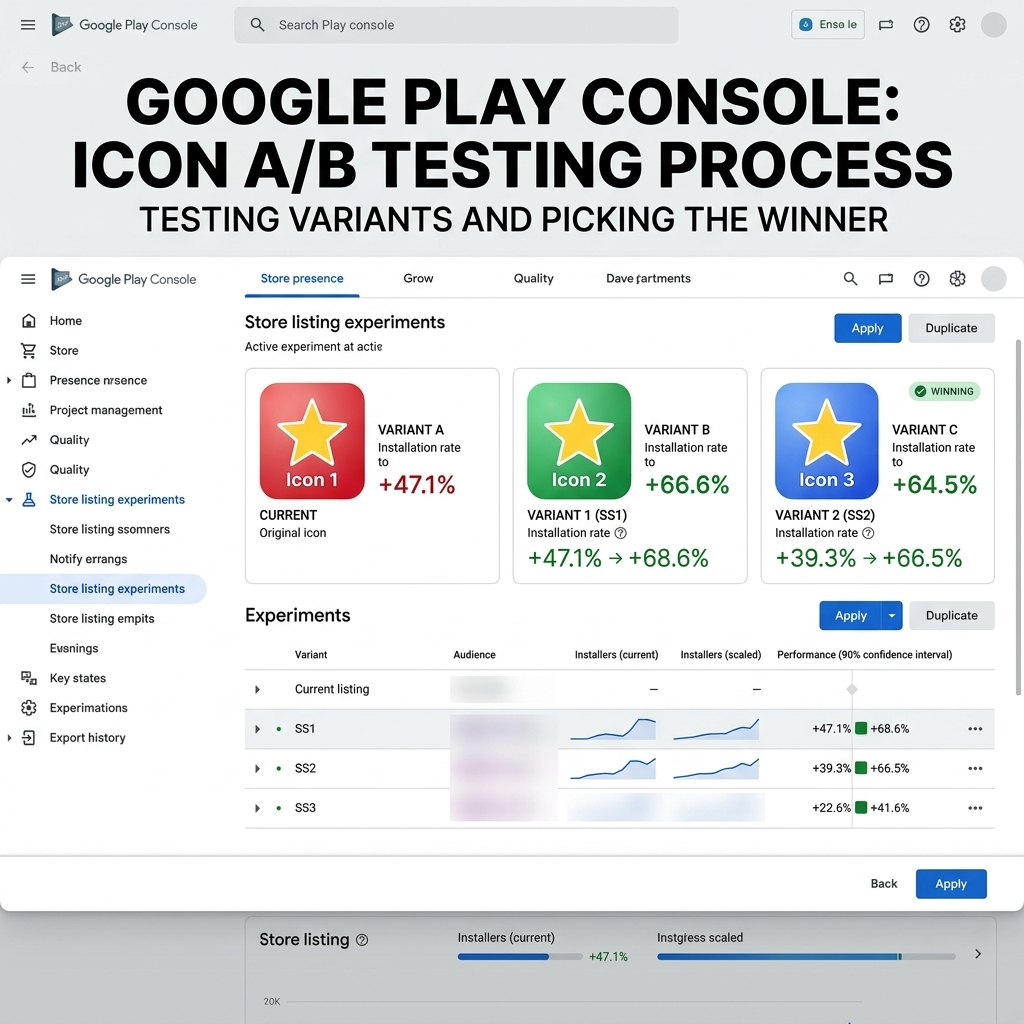
Testing method: run store experiments with controlled variants and change one dominant variable at a time (shape, color or symbol hierarchy). A better icon improves top-of-funnel taps, which increases total install opportunity.
Question 11: Do ratings and reviews affect ASO ranking?
Yes — directly and indirectly. Directly, rating and review trends are quality signals that support ranking confidence. Indirectly, better ratings increase conversion, and better conversion strengthens behavioral performance and ranking.
Metrics to watch: average rating, recent rating trend, review velocity, sentiment distribution and recurring issue themes.
Question 12: How can I improve app ratings?
Use a product-first, timing-correct approach:
- Fix core pain points first. Crashes, login issues, paywall confusion and performance lag must be addressed before prompting.
- Prompt at satisfaction moments. Ask after users complete a value action — a milestone, a finished task, a first successful outcome.
- Segment prompts. Avoid asking new or frustrated users too early.
- Close the feedback loop. Respond to critical reviews with specific fixes and support paths.
- Build release hygiene. Ship bug fixes regularly and explain improvements clearly in release notes.
Never use manipulative tactics. Sustainable rating health comes from product reliability + smart prompt timing.
Question 13: What metrics should I track for ASO?
Track ASO as a funnel plus a quality layer.
- Keyword rankings by market
- Share of ranked keywords
- Category visibility trends
- D1 / D7 / D30 retention
- Uninstall trends
- Crash-free sessions
- Trial start / purchase conversion
- Revenue per install & LTV
Do not celebrate install growth if retention quality declines.
Question 14: What is ASO A/B testing?
ASO A/B testing is controlled experimentation on listing elements to improve measurable outcomes. What to test: icon, screenshot sequence, screenshot copy, video presence or sequence, and short value-proposition variants.
- One major hypothesis at a time
- Adequate sample size
- A stable test window
- A clear success metric (TTR or CVR)
- Post-test validation with downstream quality metrics
Example hypothesis: “Outcome-first screenshot headlines will increase CVR by 10% in the productivity segment.” Test, validate, ship the winner, and start the next cycle.
Question 15: Should I localize my app listing?
Yes, if you target multiple markets — localization is a growth multiplier. And it is not only translation: it is adaptation of keywords, messaging tone, cultural context, visual examples and feature priorities. Users search in their native language, intent vocabulary differs by market, and conversion improves when a listing feels local.
- Prioritize the top opportunity markets
- Build local keyword sets per market
- Adapt screenshots and copy to local context
- Monitor metrics market by market
Localized relevance often outperforms global generic pages.
Question 16: How often should ASO be updated?
Speed up updates after a major product change, after entering a new language market, or after a sudden conversion or ranking drop. ASO without a cadence goes stale — store ecosystems and competition change continuously.
Question 17: Can paid ads help ASO?
Yes, when used correctly. Paid campaigns support ASO by generating controlled traffic for creative learning, increasing data velocity during tests, and helping new listings gain initial behavioral signals.
But there are boundaries: paid traffic quality can differ from organic, and ad performance is not a perfect proxy for organic behavior.
Use paid to accelerate learning and coverage. Use ASO to reduce long-term acquisition cost and stabilize organic volume. They are one coordinated system, not competing channels.
Question 18: What are common ASO mistakes?
- Targeting only high-volume keywords with no realistic path to rank
- Keyword stuffing that damages readability
- Changing too many variables at once (no causality)
- Ignoring creative optimization
- Not localizing high-potential markets
- Ignoring negative review themes
- Tracking installs only, not retention and LTV
- Treating ASO as a one-time pre-launch task
Professional correction: use hypothesis-based cycles with measurable outcomes at each funnel stage.
Question 19: Is ASO a one-time task?
No. ASO is an ongoing optimization program — competitors update listings, user search behavior evolves, stores change ranking and merchandising behavior, and your own product changes with every release.
ASO loop
Question 20: Can small apps compete with big apps in ASO?
Yes, with a precision strategy. Large apps have scale, but small apps often move faster and can outrank them on specific high-intent terms. Small apps win by dominating focused niche intent clusters, owning long-tail keywords first, shipping faster creative iterations, sharpening value-proposition clarity and keeping better ratings in niche communities.
Final takeaway
ASO excellence is not about one trick. It is a repeatable, evidence-driven operating system for growth. Executed properly across metadata, creatives, localization, rating health and experimentation, ASO produces durable organic acquisition and stronger app economics on both iOS and Google Play.
Over to you 👇
💬 Which of these 20 questions do you get asked most? Tell me in the comments.
👥 Know someone launching an app? Send this guide to them.
♻️ Found it useful? Share it with your team.